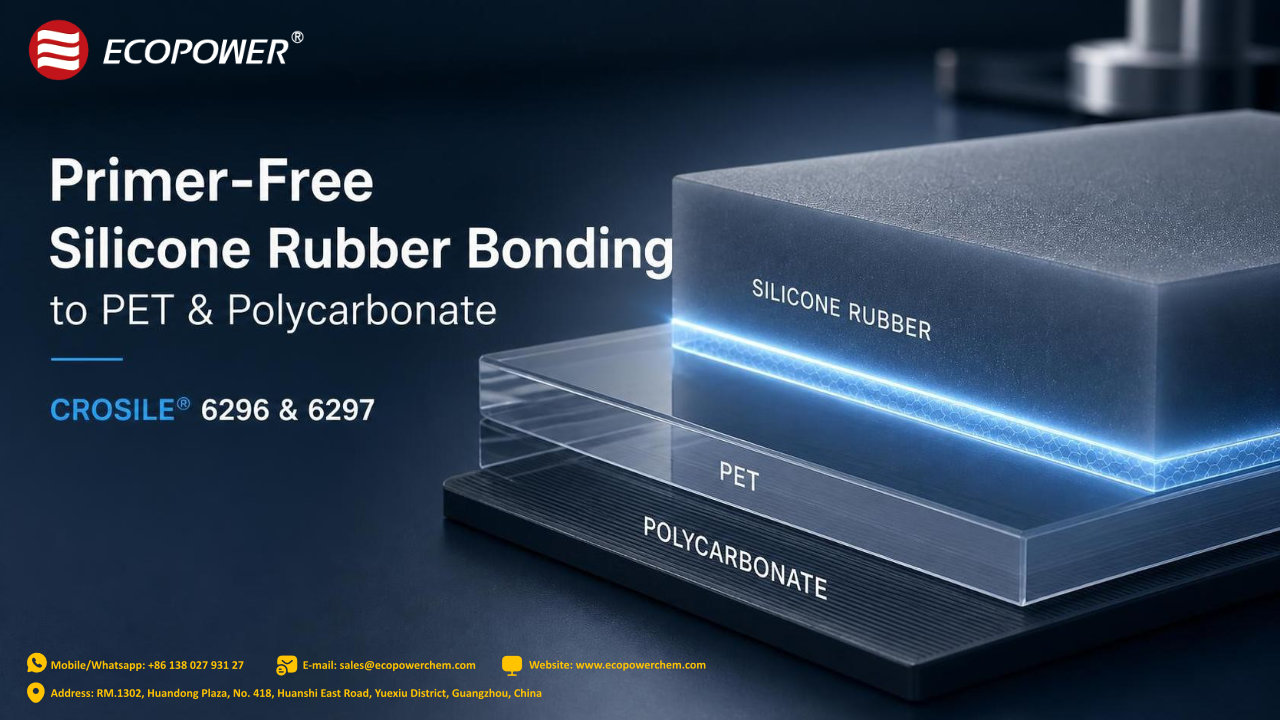
Promotores de adhesión de caucho de silicona para unión de PET, PC y PA
Crosile® 6296 y 6297 — Diseñados para una unión de silicona más fuerte y sencilla
El desafío: una unión fiable de silicona con plásticos
La unión del caucho de silicona con materiales polares como el policarbonato (PC) y el poliéster (PET) ha sido durante mucho tiempo uno de los desafíos más exigentes en la fabricación de precisión. Las soluciones tradicionales de imprimación para caucho de silicona añaden pasos adicionales, aumentan la complejidad del proceso y a menudo ofrecen resultados inconsistentes.
¿Qué pasaría si pudiera omitir la imprimación y obtener una mejor adhesión? Eso es exactamente lo que ofrecen Crosile® 6296 y 6297.
La solución: promotores de adhesión de silicona específicos para sustratos
Los promotores de adhesión de caucho de silicona Crosile® están diseñados para adaptarse a sustratos específicos a nivel molecular. Se acabaron los compromisos de una solución única para todos. Cada producto Crosile® está diseñado específicamente para su sustrato objetivo.
| Producto |
Diseñado para |
Qué lo hace diferente |
| Crosile® 6296 |
PET / Poliéster |
Los grupos epoxi + que contienen hidrógeno penetran en las superficies de PET para una unión interfacial resistente |
| Crosile® 6297 |
PC / Policarbonato |
Los grupos epoxi + fenilo proporcionan una adhesión duradera con una estabilidad térmica superior |
| 6296 + 6297 (mezcla 1:1) |
PA / Poliamida |
La formulación combinada amplía la capacidad de unión a sustratos de poliamida |
Crosile® 6296: Su solución para la unión de PET
Cuando su aplicación requiere la unión de caucho de silicona con PET, Crosile® 6296 ofrece resultados.
Por qué funciona:
- Los grupos funcionales epoxi se unen químicamente con los grupos éster de las superficies de poliéster
- Los grupos que contienen hidrógeno se entrecruzan directamente con sistemas de silicona curados con platino
- La baja viscosidad (7–11 mPa·s) garantiza una cobertura rápida y uniforme, ideal para líneas de recubrimiento de alta velocidad
Dónde se utiliza:
- Encapsulación de placas de circuito flexibles
- Laminación de etiquetas electrónicas
- Unión de marcos de pantalla
Crosile® 6297: Su solución para la unión de policarbonato
Para aplicaciones exigentes de unión de policarbonato, Crosile® 6297 está diseñado para ofrecer un rendimiento superior.
Por qué funciona:
- Los grupos epoxi se anclan firmemente a los grupos carbonato de las superficies de PC
- Los grupos fenilo aportan estabilidad térmica y resistencia a la degradación con el tiempo
- La mayor viscosidad (150–350 mPa·s) evita el descolgamiento y garantiza una cobertura uniforme
Dónde se utiliza:
- Sellado de faros de automóviles
- Ensamblaje de lentes ópticas
- Unión estructural de dispositivos inteligentes portátiles
¿Por qué cambiar de los imprimadores tradicionales de silicona?
Crosile® no es una imprimación, sino un aditivo promotor de adhesión que se incorpora directamente a tu formulación de silicona. Eso significa:
| Proceso tradicional con imprimación |
Proceso Crosile® |
| Aplicar imprimación al sustrato |
Omitir este paso |
| Esperar a que se seque la imprimación |
Omitir este paso |
| Aplicar silicona |
Añadir Crosile® directamente a la silicona (0,6 %–1,4 %) |
| Esperar una cobertura uniforme |
Lograr una unión molecular uniforme |
¿El resultado?
- Menos pasos del proceso
- Tiempos de ciclo más rápidos
- Calidad más consistente
- Más del 80 % de mejora en la resistencia al pelado (ASTM D903)
Diseñado para sistemas de silicona de curado con platino
¿Te preocupa la compatibilidad con el catalizador? Crosile® está diseñado teniendo eso en cuenta. Tanto 6296 como 6297 son:
- Sin aminas — sin envenenamiento del catalizador
- Sin azufre — sin reacciones secundarias no deseadas
- Totalmente compatibles con catalizadores de platino y sistemas de caucho de silicona de curado por adición
Tu proceso se mantiene limpio. Tus resultados se mantienen consistentes.
Rendimiento comprobado en condiciones exigentes
Crosile® no solo funciona en el laboratorio, también rinde en el mundo real.
| Prueba |
Resultado |
| Resistencia a la temperatura |
-50 °C a 180 °C |
| Prueba de envejecimiento doble 85 (85 °C / 85 % HR) |
Aprobado: sin delaminación |
| Resistencia al calor y la humedad |
Sin grietas, sin amarilleamiento |
| Mejora de la resistencia al pelado |
>80 % frente a sin tratamiento (ASTM D903) |
Cuando tu producto necesita durar, Crosile® ofrece la durabilidad en la que puedes confiar.
Aplicaciones en múltiples industrias
Los promotores de adhesión de silicona Crosile® sirven a una amplia variedad de industrias:
Electrónica:Encapsulación de placas de circuito flexible, laminación de etiquetas electrónicas
Automoción:Sellado de faros delanteros y traseros, ensamblaje de carcasas de sensores
Óptica:Ensamblaje de lentes ópticas, unión de módulos de cámara
Dispositivos de consumo:Unión estructural de dispositivos portátiles inteligentes, adhesión de marcos de pantalla
Preguntas frecuentes
¿Cómo se une el caucho de silicona líquida al PET?
Añada Crosile® 6296 a su formulación de silicona en una proporción del 0,6 % al 1,4 %. Sus grupos epoxi y con contenido de hidrógeno crean enlaces químicos fuertes con las superficies de PET, sin necesidad de una imprimación independiente.
¿Cuál es el mejor promotor de adhesión para silicona con policarbonato?
Crosile® 6297 está diseñado específicamente para la unión con PC. Sus grupos epoxi y fenilo proporcionan una excelente resistencia de adhesión y estabilidad térmica a largo plazo.
¿Puedo unir caucho de silicona a PA/poliamida?
Sí. Mezcle Crosile® 6296 y 6297 en una proporción de 1:1 para lograr una unión fiable del caucho de silicona líquida a sustratos de poliamida.
¿Funcionará Crosile® con mi silicona de curado por platino?
Sí. Crosile® no contiene aminas ni azufre, por lo que es totalmente compatible con sistemas catalizadores de platino. No existe riesgo de envenenamiento del catalizador.
¿En qué se diferencia Crosile® de una imprimación de silicona?
Crosile® es un aditivo, no una imprimación. Se añade directamente a su formulación de silicona, eliminando pasos adicionales de aplicación y logrando una unión más fuerte y uniforme.
¿Listo para simplificar su proceso de unión?
Nuestro equipo técnico está preparado para ayudarle a encontrar la solución Crosile® adecuada para su aplicación. Solicite una muestra o programe hoy una consulta técnica.
Embalaje:1 kg/botella — cantidades flexibles para pruebas de I+D hasta producción a gran escala.
Nota: Los datos de rendimiento se basan en pruebas de laboratorio. Los resultados pueden variar según las condiciones específicas del proceso. Contáctenos para obtener orientación específica para su aplicación.
Crosile® — Uniones más fuertes. Proceso más sencillo. Mejores resultados.
 Whatsapp us